


Some time ago I have published the post on Bitcoin Submarine Swaps and noted that using this feature and then sending those Bitcoin to a crypto exchange is a 100% guarantee of getting your account investigated and blocked. Why? Exactly because of AML aspect of the swap. Let’s deep dive into the AML side of crypto and figure out how we can prevent such unwanted events as account block.
What is AML in crypto?
Everybody knows that AML refers to Anti-Money Laundering or how the governments fight against “dirty” money. When we talk about crypto it can be stolen money, money related to transactions on the darknet market, transactions with sanctioned entities etc. Since the blockchain is transparent, it makes it easier to track such transactions. What happens then is that parties involved in such illegal operations get their crypto addresses marked with certain percentage of “bad” crypto.
Let’s make an example. Hacker stole 1 Bitcoin from a crypto-exchange. Since everything is recorded into the blockchain, the exchange sees that 1 Bitcoin was sent from their Wallet A to hacker’s wallet B. They will inform other exchanges that Bitcoin located on that wallet is stolen so that in case hacker sends it to another exchange they will hold it. The stolen crypto will be marked. And since all the connections can be tracked, all wallets which will interact somehow with the stolen crypto will receive some % of risk level. So, if this hacker sends 0.01 Bitcoin with 100% risk to your wallet with 0.01 Bitcoin with 0% risk, your wallet will now have 50% of risk. In case you decide to send this crypto to an exchange, they will see that part of this crypto is stolen and they will block your account.
Of course, this is very simplified approach because stolen crypto usually makes hundreds of hops but the main idea is that you may not even know that you got red-flagged Bitcoin.
What is crypto AML check
AML check allows you to view the risk level of the wallet or transaction. Services like Crystal Blockchain evaluate all connections and transactions of the wallets involved and assign a risk score.
So, for example you withdraw your crypto from a well known crypto exchange to your offline wallet. This transaction will have a minimum risk score. However if you exchange your crypto via some DEX, very likely that your transaction will receive medium to high risk scores, because there are a lot of grey crypto on those exchanges. If you try to use submarine swap in Bitcoin, you will most likely get some stolen Bitcoin with a maximum risk score.
How AML report looks like
Let’s see how typical AML report looks like. We will take a random transaction from Bitcoin mempool and see what it relates to.
Bitcoin address: 1FFg7cotGTKhHNBSz3U5FVW9Q6YxBXB4ML
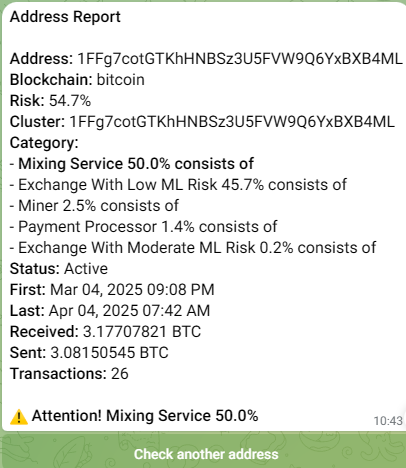
This is an example of a high risk transaction where 50% of its funds went through the mixing service. Mixing service is a process of sending Bitcoins to hundreds of different address so that it becomes impossible to track the origins and real beneficiaries. You will say that it’s good service to maintain privacy and we fully agree. But also illegal and stolen money goes through mixing and that’s why most exchanges will recognize this transaction as high-risk and most likely suspend the account.
So, imagine you buy Bitcoin through some p2p exchange and those Bitcoins are sent to your address at CEX (central exchange like Coinbase, Binance etc).
How to do an AML check
The easiest way is to run AML via Telegram Bot (@AMLpapa). Telegram is an instant messenger and it’s application can be found on AppStore to Google PlayStore. After that you will be able to use this bot to run AML checks.
Open Bot’s page and go to the menu, choose AML:

Enter wallet address or transaction hash.
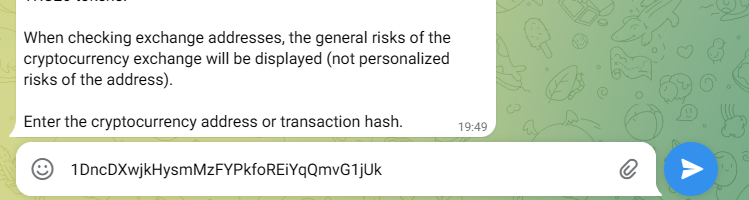
Press send and wait for the report to be generated. It will look like the one below:
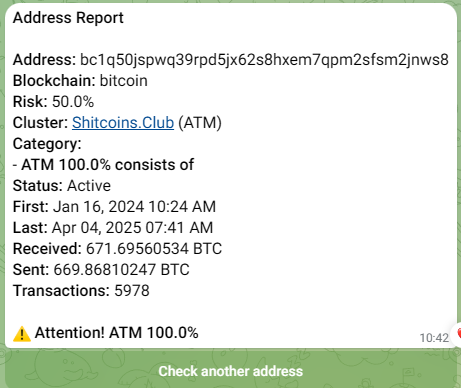
Before you can run the reports, you will need to top up the balance of the bot. 1 AML check costs around $1.
Pay attention to wallets and transactions which has yellow sign “Attention!”. This means that it’s very risky to send this Bitcoin to the CEX. In general anything above 2% in categories like Sanctions, Enforcement action, Darknet, Gambling is risky.
Conclusion
In this article I tried to cover the basic idea of AML in crypto. I from my side can tell, that AML is pretty much a problem nowadays, because this creates a room for abuse from central exchanges. We know hundreds of stories when people crypto has been blocked for indefinite period of time until they can prove the crypto is legal and this is not always easy to do. You might not even be aware that crypto which you bought 10 years ago and stored on the hardware wallet was a part of, let’s say, stolen crypto. Then when you decide to cash out, you get these problems. But now you have a tool which can save you money, time and nerves.









People reacted to this story.
Show comments Hide comments[…] [16/04/2025]: In our recent article, we explain the AML aspect of Bitcoin in more details and also show how to run AML checks of […]